

Thanks to the 104 of you who subscribe to “Diary of a YOPD” and the 185 people who took the time to read my last update (which was some time ago now).
Help this newsletter to reach more people by subscribing, sharing, and forwarding to others. If you have a Substack account, then likes, comments and restacks help too!
I dictated the following into the Notes app on iPhone on my morning walk to the tube station. (The below is lightly edited for coherence.)
I was determined to get something written today.
There is a book I once read called “The War of Art” by Steven Pressfield. The book’s basic theme is how creativity and ideas don’t just come on demand when you want them to. You have to dedicate time - you have to set aside time to write even when you don’t feel like it, in the pursuit of inspiration.
The book talks about the concept of the muse, where creativity stems from. And how it has to be tapped into, tuned like an old radio dial. You don’t just press a button and immediately hear a clear signal.
So here I am carving out time for the first time in too long, carving out some time to dedicate to this blog again, and share some ideas I’ve been having recently.
My lack of updates has not been due to a lack of ideas.
This blog is something I’m proud of, and the failure to update it for more than three months (something I’m not proud of. It’s not intentional. It’s too long a period to recap everything which has happened, but broadly it’s been a quarter of ups and downs.
Because one of the key things I’ve been thinking about a lot over the past few months is how communication from a number of mediums is just harder now. It takes more effort, it takes longer, it takes a determination which isn’t always there.
Then I got to the station, where other people are around, and you kind of have to stop talking out loud to nobody.
I should have said. The above was dictated on the morning of July 15th.
That three-month absence from posting to this blog is now nearly eight months.
Again, it has not been due to a lack of ideas.
As I was saying above before cutting myself off to walk into the ticket hall, Parkinson’s makes communication more difficult.
This is especially true when you are trying to convey something meaningful or personal which requires time to think. To construct, demolish, and rebuild thoughts until they resemble the point you’re trying to get across.
Quick and instinctive ideas, messages or replies are only slightly easier.
When using a laptop, I’m now largely typing with one hand (left) while offering token gestures to the other - in the style of when trying to manage a toddler who wants to ‘help’ you with a task - to keep it from feeling left out altogether.
“OK right hand, I want you to perch carefully above the four arrow keys. Be ready to press them whenever required…”
“Yes, right hand! Great job pressing the Enter key. High five!”
I now largely use dictation software in the form of Wispr Flow for passages of text or daily replies to emails, etc. As good as that is, and it is the best software I found for the task, it doesn’t avert the need for a manual review and edit(s) of almost every sentence you write.
So your choice is between slow and one-handed or quicker but with the need to rewrite as you go, and be in a location where you can speak out loud without interfering background noise or verbally intruding upon the nearby audience, which has no choice but to hear.
That same dictation software has an iOS app, but the social limitations still apply. Which explains, in case you were wondering, why the text quoted above was dictated on a 6:45am walk to the tube station. It’s a rare everyday opportunity for outdoor solitude.
Typing on a phone is a similarly one-and-a-half-thumbed affair. However, the need to hold the device, combined with the slight tremor in my right thumb, opens the door to autocorrect errors and unwanted punctuation.

In a personal and professional world where more people are trying to contact you via an increasing number of means, around the clock, the pressure to (slowly) reply in a timely fashion builds cumulatively.
In the personal and social senses at least, you don’t mind the inbound. Connection matters. You want the conversations, the humour, the links, the ideas, the recommendations, the invites.
However, much like the delay in updating this blog, despite having something to say, the impediments to quickly replying, combined with the flow of new updates to take in, can mean you miss certain moments entirely.
Is this post just an elongated way of apologising to people for being poor at keeping in touch? Perhaps.
In-person conversation should be the way around these issues, but in the 18 months since diagnosis, I’ve learned that few things remain as straightforward as you’d like them to be.
Parkinson’s can affect your speech and communication in a variety of ways. This page on the Parkinson’s UK website provides a good summary.
Changes I’ve noticed include a quieter speaking volume (hypophonia), a slight stammer on specific sounds and occasional speeding up mid-sentence.
These are all entirely common symptoms, although according to my neurologist medication (more on that to come in a future post) does little to treat these ‘axial’ impacts compared to the improvements it can have on motor symptoms.
I’m in the process of being referred to a speech and language therapist for regular vocal exercises to try and develop my decibel levels and become more comfortable speaking at what feels internally like a higher volume. Another addition to the optimal weekly routine.
I’ve never had anything like a classically ‘loud’ voice, but operating at this lower volume quickly becomes demoralising.
Consistently being asked to repeat yourself is one thing, but the prospect of socialising in noisy environments such as a pub has become mildly daunting knowing that you’ll likely spend the majority of the time struggling to be heard.
The temptation is to avoid putting yourself in those settings but that is equally isolating albeit in a different way.
Be it typing, tapping, or talking, communication just requires more effort these days.
Whether it be the extra focus and concentration needed to steady yourself and send an accurate message at the first time of asking, or the extra breath you take to provide an adequate oomph in your voice to try and seamlessly take part in a group conversation.
Actions and behaviours which were once instinctive now require a degree of thought and preparation that wasn’t previously necessary.
The frustrations of having a condition like Parkinson’s are 50% the new physical realities and 50% the energy levels required to navigate them with time-consuming and only slightly adequate workarounds.
So, while it may take longer to produce posts like this than I would like, the catharsis which comes from having a forum where you can be heard and understood at scale is worth the trade-offs. For now, at least.
This week in the Parky blogosphere
Below are some recommendations on posts, initiatives and people relating to Parkinson's, which I believe are some of the best representations of the online #PDcommunity.
—
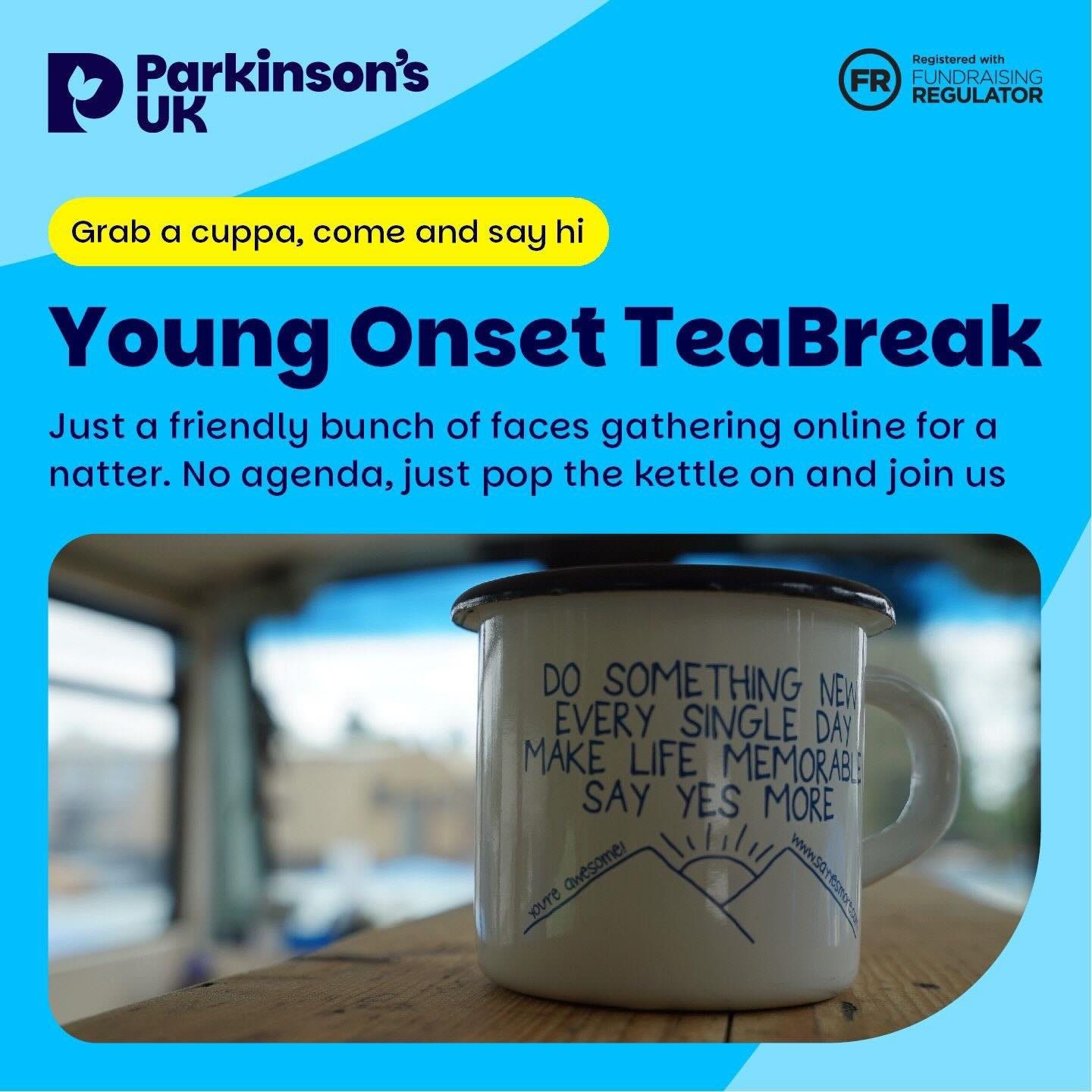
On the subject of connection and understanding, the second Wednesday of each month presents an opportunity to meet other people with YOPD in a relaxed online setting.
Talking to strangers on Zoom may not be everyone’s idea of fun, but I have joined, I think, three of these sessions now and I’ve got progressively more out of each one.
It’s 45 minutes a month where you can breathe out and unapologetically be yourself around people who ‘get it’ and support each other.
You have to engage in and support initiatives you want to see in the world. The next one of these sessions is Wednesday, December 10th at 11 am. So, if you see this in time, send me a message and I can pass on the details of how you can join in.
—
This platform recently saw the unfortunate but completely understandable departure of Emma Stubbs. You can read her farewell post in full at the link above and an extract below.
Her “Who Stole My Dopamine?” newsletter was the first I found when searching for online Parkinson’s voices, and one of a few which helped convince me to start sharing my own experiences on Substack. Her writing on the subject was expressive, warm, and relatable.
Yet, when your energy reserves are finite and diminishing, Parkies have to be unfortunately selective about where those energies are directed.
I’m stepping away before this becomes just another sad, slow chronicle of decline. You deserve better. We all do.
So this is me saying goodbye. Thank you for every story, every laugh, every bit of love you’ve thrown my way. You’ve kept me upright, at least metaphorically, when my actual body refused to cooperate.
Remember that degeneration isn’t next week. You are still you. And humour is armour even when your trousers are backwards and your bra strap has staged a full-scale rebellion.
One further thought from the last eight months
This update may not have been the cheeriest read, so I’m loath to finish on a sad note, but I recommend watching the interview below with former England rugby player Lewis Moody.
Motor Neurone Disease is not the same thing as Parkinson’s, and this is not an attempt to compare the two conditions, but some of the themes in this conversation struck a chord with me.
His description of seeking treatment for a seemingly innocuous shoulder pain, to being referred to a neurologist, to being given the unwanted news of an entirely different future to what was previously planned will be relatable to many in the Parkinson’s community.
People who are seriously or terminally ill are always called ‘strong’, but the clarity and selflessness with which Lewis speaks about his and his family’s outlook is genuinely powerful and motivating.
The world is full of people walking around being given life-changing news every day.
If all anyone is guaranteed is today, then actively do what you can to make it a positive one for yourself and others around you.
Watch the full interview (UK only) here, or a snippet below.
Get in touch
If you'd like to discuss anything related to this newsletter or something I've written, you can email me, leave a comment below or reach me on a couple of different social media platforms.
One final thing…
A main reason for writing this newsletter at all is to find and connect with people in a similar position.
YOPD is a niche condition and potentially a lonely one for people without a physical or digital support network.
Please feel free to share this your networks to help it find someone who may benefit from being part of a relevant community.